
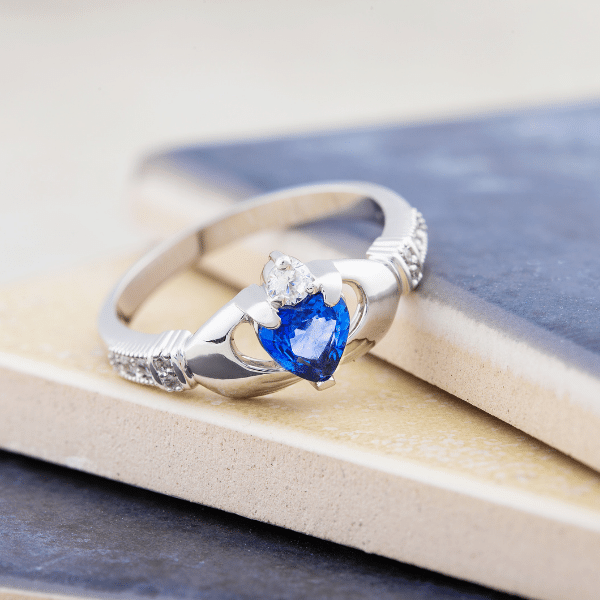
Love, affection and loyalty are the top meanings of a Claddagh ring. The Irish saying synonymous with the Claddagh ring is: “With these hands, I give you my heart and crown it with my love”. It’s very fitting, since the ring features clasped hands sheltering a heart, with a crown to symbolise love, strength, and everlasting loyalty. Although Claddagh rings will often feature in traditional Irish wedding ceremonies, they also make for beautiful family and friendship rings.
Who should wear a Claddagh ring?
Claddagh rings can be worn by anyone, and can hold different meanings. It is said that the Claddagh ring represents many forms of love, with the hands representing friendship and platonic love, the heart representing true romantic love, and the crown symbolising loyalty.
People often choose a Claddagh ring as an engagement ring, or a wedding ring, but they can also be worn prior to meeting a life partner.
In Irish tradition, the Claddagh ring would be passed from mother to eldest daughter and kept in the family as a form of inheritance.
How you wear the Claddagh ring can indicate what it means to you at that time, and therefore it is helpful to know the true Claddagh ring's meaning in reference to these ways of wearing it.
Can you wear a Claddagh ring if you’re not Irish?
Yes, absolutely.
While Claddagh rings were traditionally worn by Irish people, they have become popular across the globe. Those with Irish heritage may find the ring even more meaningful, but as a symbol of everlasting love regardless of background, anyone can wear a Claddagh ring.
History of the Claddagh ring
The Claddagh ring is thought to have originated in the “Claddagh” meaning “shore” of the Irish city of Galway. However, there are many different origin stories around the very first Claddagh ring.
One story claims that Margaret Joyce, a wealthy woman from Galway, married a wealthy Spanish merchant. After he died, she spent her inheritance building some of the greatest infrastructure of the time in Galway. It’s said that as a reward for the bridges she built, the first Claddagh ring was dropped by an eagle into her lap as a gift.
Another, more commonly believed story credits the first Claddagh ring to a man named Richard Joyce. Joyce was sold into slavery after being captured off the coast of the West Indies. Upon being sold to a goldsmith, Joyce learnt the trade and was later freed with this new skill under his belt. Once free, he returned to Galway to start his own jewelry business making Claddagh rings. One of the oldest discovered Claddagh rings features Joyce’s mark, and currently sits in Galway City Museum.

Rings meaning “hands joined in faith”
Claddagh rings get their sentiment from a very old tradition that celebrates the joining of hands to represent loyalty. The symbolism of joining hands in faith is an ancient tradition, from which the term “asking for someone’s hand in marriage” stems. The hand represents much more than a physical body part, and has come to represent love, connection, and fidelity.
Rings featuring hands clasped together are also known as “fede rings” meaning “hands joined in faith”. They have been prominent since the 12th century, and were popular during the medieval period in the UK and Europe. Prior to this they were also used by the ancient Egyptians, ancient Greeks, and Romans.
How to wear a Claddagh ring
The Claddagh ring has a rich history, and can mean many different things depending on how it's worn.
How to wear a Claddagh ring when single
If you’re single you should wear the Claddagh ring upside down, so that the heart is facing away from you. This signals that you’re open to love and your heart is not promised to another.
How to wear a Claddagh ring when in a relationship
In a relationship, you should keep the ring on the right hand but turn the Claddagh ring towards you to indicate that your heart is committed.
How to wear a Claddagh ring when engaged
When engaged, the ring moves to the left hand, and onto the ring finger. The left ring finger was traditionally chosen for the wedding ring as people believed that there was a vein that went from the left ring finger to the heart. If you’re engaged, you should keep the heart outward to show that you’re not yet married.
How to wear a Claddagh ring when married
When married the Claddagh ring should stay on the left hand, with the heart facing your body. This symbolises lifelong commitment.

Claddagh rings for any occasion
While Claddagh rings are definitely love rings, they can be gifted for a variety of occasions. Whether you’re celebrating a loved ones birthday, popping the question or choosing a wedding ring for you and your partner, a Claddagh ring can be a beautiful option.
If you are interested in creating a unique bespoke ring for yourself or your partner, we would be delighted to help bring your creation to life. For more inspiration, shop our range of wedding rings now.







 Unlock private sale access
 Birthday privileges
 Plus a world of exclusives, curated for you.


Love, affection and loyalty are the top meanings of a Claddagh ring. The Irish saying synonymous with the Claddagh ring is: “With these hands, I give you my heart and crown it with my love”. It’s very fitting, since the ring features clasped hands sheltering a heart, with a crown to symbolise love, strength, and everlasting loyalty. Although Claddagh rings will often feature in traditional Irish wedding ceremonies, they also make for beautiful family and friendship rings.
Who should wear a Claddagh ring?
Claddagh rings can be worn by anyone, and can hold different meanings. It is said that the Claddagh ring represents many forms of love, with the hands representing friendship and platonic love, the heart representing true romantic love, and the crown symbolising loyalty.
People often choose a Claddagh ring as an engagement ring, or a wedding ring, but they can also be worn prior to meeting a life partner.
In Irish tradition, the Claddagh ring would be passed from mother to eldest daughter and kept in the family as a form of inheritance.
How you wear the Claddagh ring can indicate what it means to you at that time, and therefore it is helpful to know the true Claddagh ring's meaning in reference to these ways of wearing it.
Can you wear a Claddagh ring if you’re not Irish?
Yes, absolutely.
While Claddagh rings were traditionally worn by Irish people, they have become popular across the globe. Those with Irish heritage may find the ring even more meaningful, but as a symbol of everlasting love regardless of background, anyone can wear a Claddagh ring.
History of the Claddagh ring
The Claddagh ring is thought to have originated in the “Claddagh” meaning “shore” of the Irish city of Galway. However, there are many different origin stories around the very first Claddagh ring.
One story claims that Margaret Joyce, a wealthy woman from Galway, married a wealthy Spanish merchant. After he died, she spent her inheritance building some of the greatest infrastructure of the time in Galway. It’s said that as a reward for the bridges she built, the first Claddagh ring was dropped by an eagle into her lap as a gift.
Another, more commonly believed story credits the first Claddagh ring to a man named Richard Joyce. Joyce was sold into slavery after being captured off the coast of the West Indies. Upon being sold to a goldsmith, Joyce learnt the trade and was later freed with this new skill under his belt. Once free, he returned to Galway to start his own jewelry business making Claddagh rings. One of the oldest discovered Claddagh rings features Joyce’s mark, and currently sits in Galway City Museum.
Rings meaning “hands joined in faith”
Claddagh rings get their sentiment from a very old tradition that celebrates the joining of hands to represent loyalty. The symbolism of joining hands in faith is an ancient tradition, from which the term “asking for someone’s hand in marriage” stems. The hand represents much more than a physical body part, and has come to represent love, connection, and fidelity.
Rings featuring hands clasped together are also known as “fede rings” meaning “hands joined in faith”. They have been prominent since the 12th century, and were popular during the medieval period in the UK and Europe. Prior to this they were also used by the ancient Egyptians, ancient Greeks, and Romans.
How to wear a Claddagh ring
The Claddagh ring has a rich history, and can mean many different things depending on how it's worn.
How to wear a Claddagh ring when single
If you’re single you should wear the Claddagh ring upside down, so that the heart is facing away from you. This signals that you’re open to love and your heart is not promised to another.
How to wear a Claddagh ring when in a relationship
In a relationship, you should keep the ring on the right hand but turn the Claddagh ring towards you to indicate that your heart is committed.
How to wear a Claddagh ring when engaged
When engaged, the ring moves to the left hand, and onto the ring finger. The left ring finger was traditionally chosen for the wedding ring as people believed that there was a vein that went from the left ring finger to the heart. If you’re engaged, you should keep the heart outward to show that you’re not yet married.
How to wear a Claddagh ring when married
When married the Claddagh ring should stay on the left hand, with the heart facing your body. This symbolises lifelong commitment.
Claddagh rings for any occasion
While Claddagh rings are definitely love rings, they can be gifted for a variety of occasions. Whether you’re celebrating a loved ones birthday, popping the question or choosing a wedding ring for you and your partner, a Claddagh ring can be a beautiful option.
If you are interested in creating a unique bespoke ring for yourself or your partner, we would be delighted to help bring your creation to life. For more inspiration, shop our range of wedding rings now.